Branding
Design
Culture
Apple: Irreplaceable or Just Well-Branded?
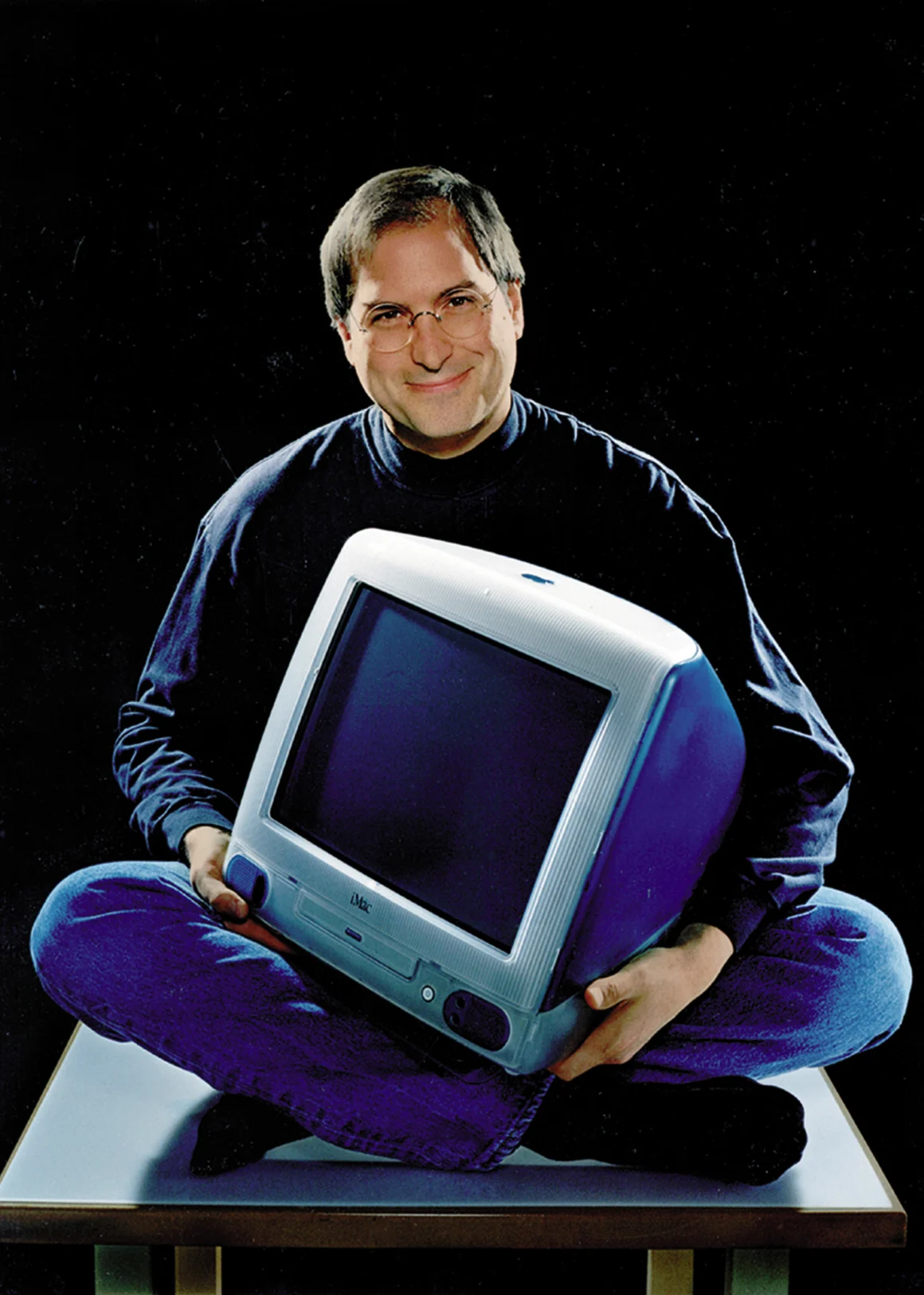
Steve Jobs with the iMac G3 (1998). Photo: Apple Inc.
There are two kinds of people in the world: those who swear by Apple and those who roll their eyes at the cult. Even the eye-rollers can’t quite escape Apple’s gravitational pull.
Maybe they don’t own an iPhone, but they’ve admired one. Maybe they question why a laptop stand costs as much as a decent phone, but they still know that Apple’s launches are cultural events, not just product releases.
Steve Jobs once said, “People don’t know what they want until you show it to them.” It’s the perfect manifesto for Apple’s brand philosophy: Apple doesn’t ignore consumers; it listens differently. Instead of waiting for people to spell out what they need, Apple anticipates and interprets unmet desires, then creates solutions that fuels demand. In doing so, it has become what branding expert Marty Neumeier calls a charismatic brand— a brand that feels irreplaceable. These are the brands that inspire loyalty, command premium prices, and achieve cultural dominance, not because their products can’t be replaced, but because they’ve convinced us they shouldn’t be.
The question, then, is this: Is Apple truly irreplaceable—or just dangerously good at convincing us it is? Let’s find out.
Charismatic Brands: What Makes a Brand Feel Unsubstitutable
Apple embodies this so strongly it’s become the prime example. Neumeier identifies three traits that fuel brand charisma as: stance, aesthetics, and emotion.
Apple’s stance has always been crystal clear: Thinking outside the box. While critics continue to insist that Apple is lacking in that area, I beg to disagree. The “Think different” campaign which dates as far back as 1997 is a famous proof as to where Apple’s stance lies. From the “1984” Super Bowl commercial positioning Apple as the rebel against conformity, to today’s positioning around privacy as a human right, Apple has consistently chosen a side. Buying Apple means buying into a tribe of creatives, dreamers, and challengers. That sense of belonging is priceless.
Then comes aesthetics. Neumeier reminds us that aesthetics is the language of feeling. Apple has long understood this. The candy-colored iMac G3 in 1998 transformed the beige computer into an object of desire. The iPod’s iconic click wheel was not just functional, it was addictive in its tactility. The unibody MacBook design in 2008 set a new gold standard for sleekness.
But Apple’s aesthetics extend far beyond product design. Their packaging is famously minimal, tactile, and almost feels like a ritual. Unboxing itself feels luxurious as we’ve seen a great deal of ASMR Apple unboxing videos.
Even down to the retail stores, with their glass walls and Genius Bars, became examples of modern design. Apple’s advertising and typography play into a seamless visual language that makes the brand feel as beautiful as the products themselves.
That leads to emotion. Apple sells confidence and identity concealed in a gadget. It understands that emotion is the glue that keeps people from switching, even when rivals offer cheaper or more powerful devices.
And here’s the Fun fact about it all: Apple often makes decisions that should, in theory, tank customer loyalty, and yet they don’t. When Apple killed the floppy disk with the iMac G3, people called it reckless. When it dropped the headphone jack on the iPhone 7, the internet howled. When it stopped including chargers in the box, critics accused it of arrogance. But within months, competitors followed, and consumers adapted. Apple doesn’t bend to cultural demand; it tells culture where to bend.
And the numbers back it up. Apple isn’t just loved; it’s bought in staggering quantities. The company’s annual revenue has soared past $383 billion in 2023, with iPhone sales alone contributing over half of that. Each new product release smashes the records of the last, reinforcing the idea that loyalty here is not casual.
People may complain when Apple changes the rules, but they still line up outside glass-walled Apple Stores on launch day, wallets open and ready to shop.
The Apple Effect: How the Brand Designs Desire
No brand stages desire quite like Apple. Everything is meticulously choreographed to Design desire. Even the unboxing of a device is an experience. The slow, gravity-assisted slide of the lid, taking about 7–10 seconds, was tested and calibrated to heighten anticipation. By the time you hold the device, your brain has already filed it under premium. I believe this appeals to our mind, they’re psychological nudges.
Apple sells us longing, carefully curated and beautifully packaged. Every September has become highly anticipated. Some even joke that Apple’s launch season rivals New York Fashion Week. A stretch? Maybe. But not by much.
The keynote? Pure theater: lights dimmed, cinematic intro videos, applause at the right moments. There’s an instant magnetic pull from just watching their release videos. You can imagine what being at the Apple Store on such a day would feel like.
And it works. iOS 7 in 2013 was framed not as a design refresh but a rebirth, “the biggest change to iOS since the iPhone.” iOS 14’s widgets and App Library sparked viral TikTok trends, turning home screens into canvases for self-expression. Even iOS 17’s Contact Posters weren’t marketed as minor utilities but as lifestyle enhancers, tiny ways to make technology feel more you. Apple’s genius is in positioning tweaks as something you’d yearn for. Not because of what the software does, but because of the story wrapped around it.
Then there’s the language. While rivals drown you in specs, Apple leans onto words that thug at your heart such as: magical, revolutionary, life-changing. It’s storytelling that bypasses logic and goes straight for your emotions. And the social signaling is unmistakable: an iPhone in your hand or AirPods in your ears is less about utility than identity. Apple doesn’t just sell devices—it sells taste, status, belonging.
Apple understands the economics of desire: what is scarce feels sacred. Product launches are tightly controlled events, streamed to millions, where leaks become part of the theater. The famous iPhone shortages? Far from accidental - they were strategy at work.. Limited availability builds anticipation, makes headlines, and fuels resale markets where a new iPhone can fetch 20–30% above retail in early weeks.
The Ecosystem as Brand Architecture
One of the most loved things about the Apple ecosystem is its web of continuity.
A note you draft on your MacBook is waiting for you on your iPhone before you’re done typing. Edits to a Keynote presentation glide across devices without the drama of cables or cloud headaches. AirDrop lets files jump between gadgets, and “Find My” makes every device both a locator and a lifeline.
What’s remarkable isn’t just that the pieces talk to each other—it’s how naturally they do it. Handoff lets you pick up an email mid-sentence on another device; Universal Clipboard means you can copy text on your iPad and paste it on your Mac as if they shared the same bloodstream. Apple has quietly engineered an invisible nervous system where hardware and software are less like tools and more like extensions of you.
Even visually, the devices echo one another. The MacBook’s aluminum shell, the iPhone’s rounded edges, the Apple Watch’s glass curve, each has its own silhouette, yet together they form a family portrait. Different shapes, different purposes, but unmistakably bound by the same DNA of design.
This is Apple’s lock-in strategy disguised as luxury. You don’t just own an iPhone, you own the way it syncs with your AirPods, unlocks your Mac, or pings your Watch. To leave the ecosystem is far from just swapping your phone, you’ve just been exiled from a life of ease and convenience.
Counterpoint: Are We Just Under a Spell?
The truth is, Apple isn’t always the best on paper. Samsung phones boast higher-resolution cameras. Windows laptops offer more ports, more customization, sometimes even more power for less money. Google’s Pixel often outsmarts the iPhone with AI-driven features. Functionally, competitors match or even outperform Apple.
And yet… it doesn’t feel the same. Sliding open a Galaxy might be technically superior, but it doesn’t come with the cultural weight of an iPhone unboxing. A Dell might run circles around a MacBook in specs, but it rarely sparks envy in a café. While competitors build excellent tools; Apple builds experiences that feel inevitable while still being excellent.
This is the powerful hand of branding at its best. It sells you hardware, belief, ritual, and identity. Apple has managed to make the rational seem irrelevant and the emotional irresistible.
The Genius of Branding, Not Just the Brand
In the end, maybe Apple isn’t truly irreplaceable. Other brands make faster chips, sharper cameras, sleeker designs. But none of them make people feel the way Apple does.
As branding expert Marty Neumeier put it, “People value feeling more than information.” Apple’s greatest product has never been the iPhone, or the MacBook. Its greatest product is perception.
Hardware ages, specs get beat, competitors catch up. But the story? The story is timeless. And that’s why, whether you’re an Apple fan or a skeptic, you can’t ignore the masterclass: Apple sells desire and Devices.